

A few weeks ago, I attended a panel on building more affordable housing hosted by Built Canada at the BDC. During the discussion, Christina Smith, the former mayor of Westmount, shared something that stayed with me. She went to visit residents who had opposed a six-story building in a neighbourhood where buildings of that height already exist. She wanted to understand why they felt that way. The project made sense on paper. It wasn’t out of scale or out of character. What she found out was that these new residents of Westmount pushed back: not because of the height, not because of density, but because they didn’t want to live next to a construction site.
That comment shifted how I think about resistance to new housing. We often frame it as a reaction to density, as if people were fundamentally opposed to change in their neighbourhood. But what if that’s not the real issue? What if residents are reacting to what they know will come before the building is even finished?
Because what people fear the most isn’t density. It’s construction.
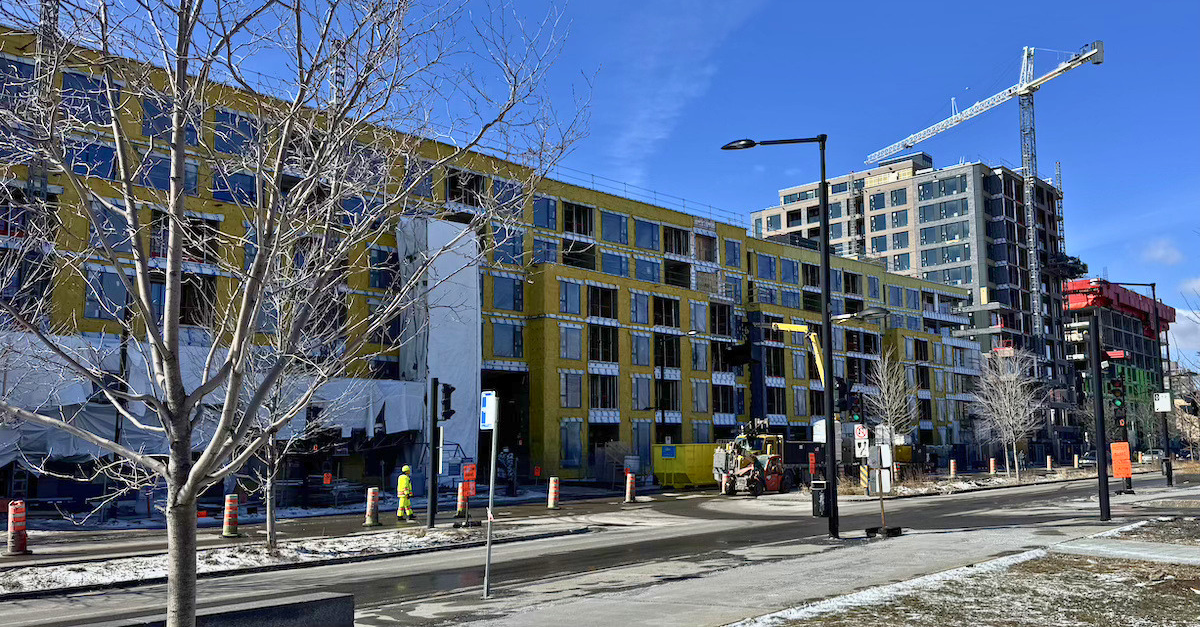
The way we build today prioritizes the construction process over everyday life. Sidewalks close, streets narrow, and public space is reorganized around site logistics. This is not because there are no alternatives, but because it is the simplest way to manage a project under current practices and constraints.
You might accept that trade-off if it meant projects were completed faster. But that’s rarely the case. Construction still takes years, while the surrounding neighbourhood absorbs the impact the entire time.
When a sidewalk is closed, that space doesn’t disappear. It gets reassigned. It becomes a place to store building materials, to park pickup trucks, or to make site logistics easier. Public space quietly turns into private support space for the project.
The cost of that system doesn’t appear in project budgets. It shows up in everyday life: in delays, in stress, in reduced comfort, and in a lower quality of life that can last for months or even years. In practice, we have created a system where it is cheaper to disrupt a neighbourhood than to organize a construction site differently. That outcome is shaped by incentives, not necessity.
This is where the conversation needs to shift. Faster and more efficient building methods already exist. Off-site fabrication, modular construction, and better coordination of materials can significantly reduce time on site and limit how much construction spills into public space. These approaches are not experimental. They are proven.
But they require planning and coordination. And under current conditions, there is little pressure to adopt them. As long as occupying public space remains inexpensive and timelines can stretch without consequence, the simplest approach continues to dominate.
If we are serious about addressing the housing crisis, we need to broaden the conversation. It’s not just about how quickly projects are approved or how many units are built. It’s also about how those projects are delivered, and how long they disrupt everyday life. Every additional month behind construction fences is another month where daily routines are more complicated than they need to be, and another month where the benefits of the project are delayed.
What I heard at that panel, and what I keep noticing in the city, points to something important. People are not just reacting to what gets built. They are reacting to what they are asked to live through while it is being built.
This is why I say:
“We don’t have a density problem. We have a construction experience problem.”
As long as building the future comes at the expense of living in the present, resistance will follow. Projects that make sense on paper will continue to face opposition on the ground, not because people are against housing or density, but because they don’t want the cost of living through construction.
It raises a simple question: how many more housing projects would get residents’ support if they didn’t make everyday life harder?
+++ Photo credits: Kim Vallee.
Taken on my way to the Children’s Hospital. A familiar scene—construction taking over the street, quietly reshaping how people move through the neighbourhood.
