


Lessons from UN17 Village in Copenhagen
Beyond Units is a series where I explore how housing shapes everyday life and invite those who build, design, regulate, and live in our cities to rethink what housing projects truly deliver.
I launched this series by presenting Papirøen where we examined how shared spaces, mixed uses, and the courage to design differently transformed an old industrial island in Copenhagen into a place that feels alive, social, and inviting for residents and the rest of the city. That project showed how design can encourage interaction and vibrancy: two essential ingredients of urban well-being.
Papirøen made me curious about something deeper. That curiosity led me to another Copenhagen project: UN17 Village. That raised several questions.
If shared public space can help a district feel more alive, what happens when a housing development is intentionally designed to support well-being at the residential scale? Not just interaction, but physical and mental health. Not just density, but belonging. Can architecture go beyond aesthetics and unit counts to actively shape how people live, age, and thrive together?
The first thing to know about UN17 Village is that it functions as a living experiment. It is a testing ground designed to demonstrate that sustainable construction can work at scale. This living lab goes beyond building techniques. It also tests social sustainability. This is the part that got my attention: they designed and activated communal spaces to reduce loneliness and encourage interaction among diverse residents.
Unique identities
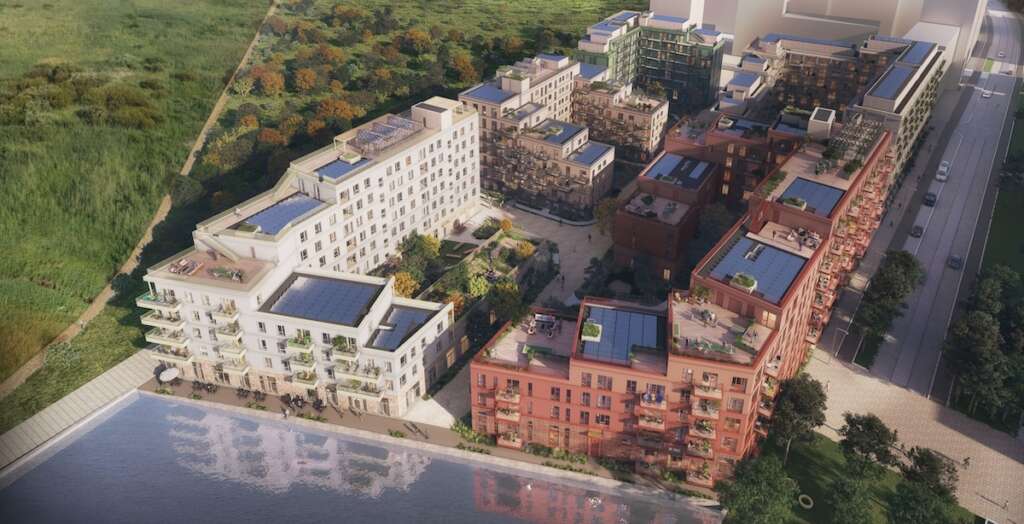
When you arrive at UN17 Village, it does not read as a single massive development. Instead of filling the site with tall, uniform towers, as is often the case here, the architects chose to distribute five mid-rise buildings along the edges of the large plot. Each building has its own material expression, colour palette, and character. Moving through the site, you sense transitions rather than repetition. You are not simply “inside a complex.” You are somewhere specific.
This non-uniformity is not cosmetic. It creates orientation, identity, and scale. All subtle contributors to well-being. Residents belong to a building with a personality, not just to an address in a large block. That sense of recognition and belonging is not trivial. It shapes how comfortable and grounded people feel in their daily environment.
More importantly, each building is shaped around a life stage rather than a generic household template. There are homes designed for young graduates and singles, others for families, others for active adults over 40, and others focused on health-conscious living. Larger shared apartments accommodate different living arrangements. Instead of defaulting to the familiar two-bedroom-for-everyone formula, the project asks a more direct question: who is this building really for, and how do these residents move through their day?
That shift changes the atmosphere. It acknowledges that households are not uniform and that different life stages bring different rhythms, needs, and forms of social life. It recognizes that well-being looks different at 25, 45, or 70. All of this unfolds within a rental model that places emphasis on belonging, a critical but often overlooked component of urban health.
Shared Life in Action
For me, what truly sets UN17 Village apart is the sheer amount of space and intention dedicated to shared life as a foundation for well-being. More than 2,000 square meters are allocated not to private apartments but to common rooms, workshops, kitchens, terraces, and circulation areas deliberately designed to encourage encounters.
At the center of the development sits Fælledhuset, the village hall. This is not a symbolic community room hidden in a basement. It is conceived as an extension of residents’ living rooms. Here, people organize workshops, lectures, yoga sessions, communal dinners, and celebrations. It signals that social life, a key determinant of mental well-being, is meant to extend beyond individual units.
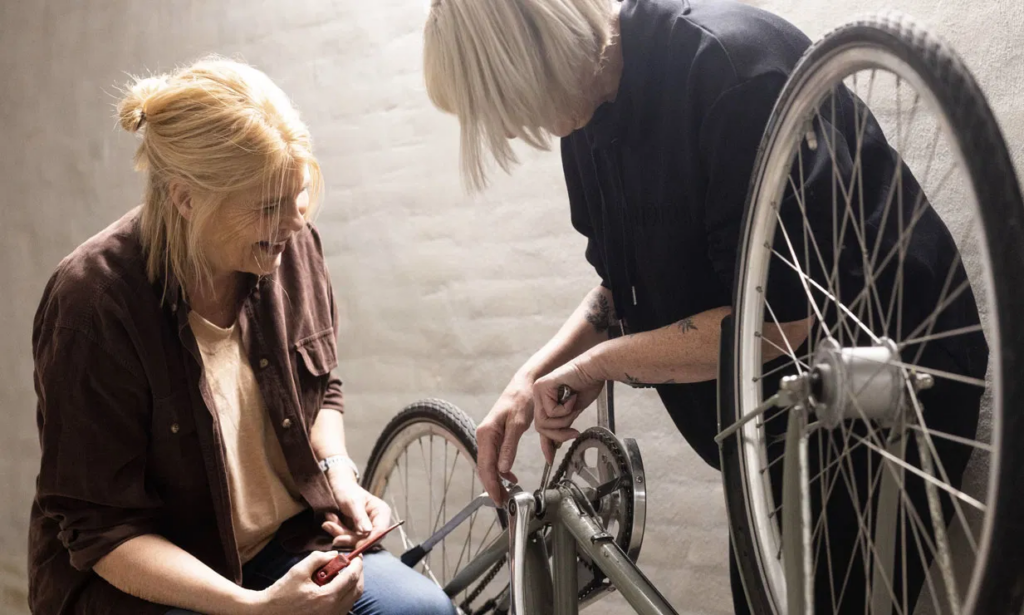
The Sharing Centre reinforces this logic. Equipped with workbenches, tools, swap shelves, and lending areas, it supports a small internal sharing economy. Residents repair bicycles and furniture together, exchange items, and borrow equipment instead of purchasing everything individually. The effect is subtle but powerful: practical cooperation strengthens trust, reduces waste, and builds social resilience.
Rooftop greenhouses and courtyard vegetable gardens add yet another layer. Gardening side by side creates low-pressure opportunities for conversation and familiarity. Access to nature, light activity, and shared purpose all contribute to both physical and mental well-being.
The physical layout of the district strengthens these intentions. Bicycles are parked in central courtyards rather than isolated garages. Circulation routes intersect. Daily movement patterns increase the likelihood of crossing paths with neighbours. These small, repeated interactions matter. They reduce isolation and reinforce a sense of community over time.
There is also a digital dimension to support social connection. A resident app allows neighbours to organize events, book shared spaces, and stay informed about activities within a community of more than 1,000 people. The physical and digital worlds reinforce one another, acknowledging that people connect in both environments.
Early Planning
This level of social infrastructure began months before the first residents moved in. The developer hired a dedicated community manager well in advance. Future renters were invited to meetings where they discussed shared interests and collectively defined how the communal spaces would be used. They were not simply handed amenities; they were involved in shaping their purpose.
In that sense, architecture set the stage, but facilitation activated it.
Within months of occupancy, residents were hosting communal dinners where they alternated who was cooking, cleaning, and just relaxing. They shared the costs of the meals. The frequency of the communal meals varies by floor, group, building, and time of year. They host board game nights, sports screenings, book clubs, arts and crafts activities, and get-togethers. They began cleaning shared areas themselves and holding one another accountable for environmental practices. A community council emerged to welcome newcomers and help shape the next phase of life in the village.

This is not accidental community. It is structured, encouraged, and supported. They all work in service of long-term well-being.
At the same time, their community model is fragile. Not every development is willing to fund, or can afford to fund, community management. Sustaining this level of engagement is harder than it looks. It often depends on the leadership and motivation of one or two residents willing to invest time and energy once formal facilitation recedes. That challenge must be solved sooner rather than later if well-being is to remain a long-term outcome rather than a short-term experiment.
Healthier Environment
UN17 Village is entirely smoke-free. So smoking isn’t permitted outside, in common areas, and inside the apartments. That choice alone says something. Health is not left to chance or to individual discipline. It is built into the rules of the place.
The materials feel natural. There is a lot of daylight. Large windows connect residents to the surrounding landscape. The lighting supports sleep rhythms. Noise levels are reduced to limit stress. These are not flashy features, but they affect how you wake up, how you rest, and how you recover at the end of the day. These features vary from building to building, which expand the levels of real-world testing.
Materials were carefully chosen, and trade-offs were made to support healthier living. Cleaner indoor air. Better environmental performance. Fewer hidden toxins. All these show that well-being was a priority from day one. It sits in the walls, the floors, in the air, in the light. From what residents breathe and touch to the social life around them, well-being dictated the decisions taken.
What UN17 Village Teaches Us
This is the sad truth. If we recognize that loneliness, aging, and social fragmentation are structural urban challenges, why do we continue to design housing as putting a roof over our head? Why is well-being so rarely treated as a primary objective of development?
UN17 Village might not provide an easy replicable model for now. As a living lab project, I’m curious to see how it evolves over time. But one thing that UN17 Village does very well is raising the bar. It suggests that housing can be conceived not just as a collection of units but as a framework for well-being. As a framework that supports connection, encourages healthy routines, and adapts to different life stages.
For those building, planning, or approving housing projects, that is the uncomfortable part. It is easier to count units than to design for well-being. Easier to minimize shared space than to increase them. Easier to assume health and connection will “happen” than to treat them as outcomes that require your attention and intention.
Building taller or denser without improving residents’ quality of life is not a sound recipe. We need more diverse housing options, designed to actively support well-being across the life cycle. This is the standard worth pushing for if we want housing to be more than shelter and to sustain healthier, more connected urban lives.
I dream of the day where well-being should be the baseline, not the bonus.
* For context, UN17 Village is in Ørestad, a planned district on the island of Amager that was built as a laboratory for modern architecture and transit-oriented living. It sits next to nature and runs on a simple formula: fast metro, safe bike lanes, and easy walking. No need for a car. The metro gets you downtown in about 12–15 minutes. Technically, it’s in Copenhagen.
