

Shared space, mixed-use, and the courage to design differently
With Beyond Units, a new series, my goal is simple: to invite developers, planners, architects, elected officials, and homeowners to reconsider what housing projects can truly offer to everyday life in our cities.
I’ll be showing real projects—designed for the Canadian climate—that challenge our assumptions about what is possible when we dare to try something different. Projects that invite is to rethink what a truly mixed-use project can be.
The first project I fell in love with is Papirøen, in central Copenhagen.
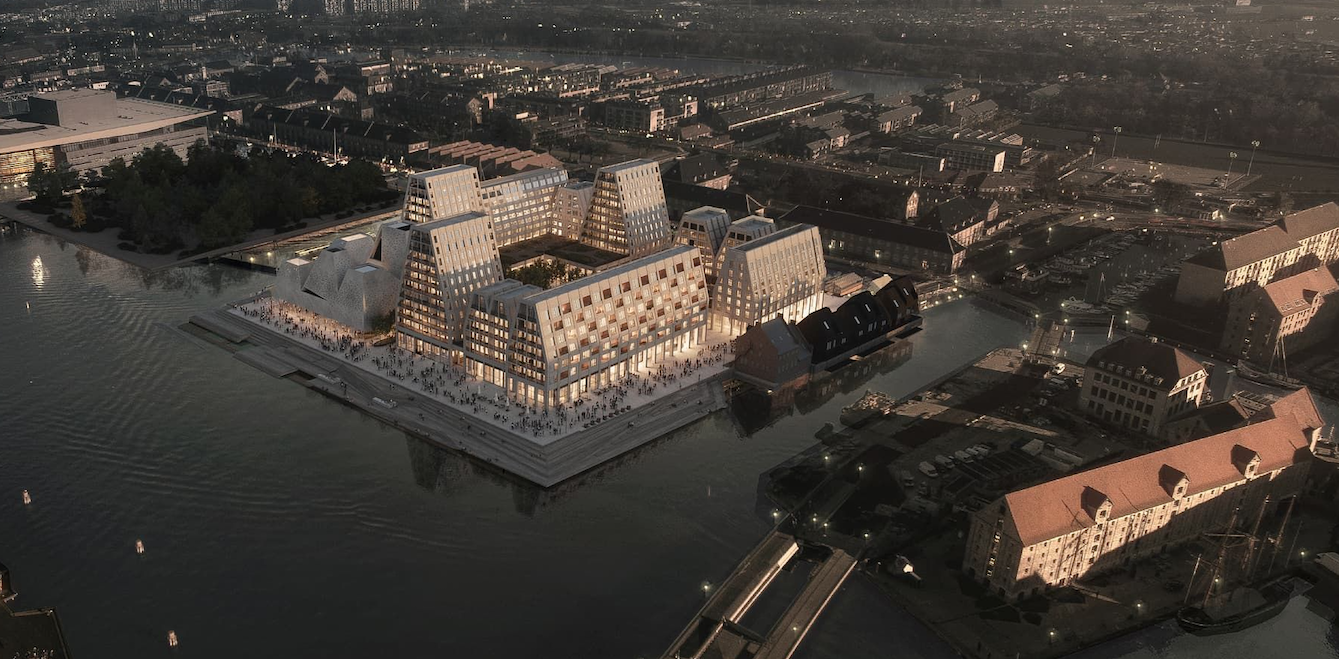
Once an abandoned industrial island that stored paper for the Danish press, Papirøen has been transformed into a lively neighbourhood that blends public life with private living in a way we rarely see in Canada.
Let’s look at what makes this project fundamentally different from what we typically build here—and what it can teach us.
1. A Shared Plaza at the Heart of the Block
The first thing that stands out is how the buildings are placed. At Papirøen, the buildings form a continuous block around a central space, a courtyard. That configuration becomes a wall that blocks the harsh harbour winds, protecting the central plaza. This design cleverly creates a microclimate that makes the courtyard more confortable for people.
Contrary to many local projects, that central place is actually useful. Because it’s accessible to everyone on the ground, it becomes a true communal asset. Who wouldn’t want a shared place where activities naturally happen? A place to socialize with friends, neighbours, and even strangers. A place where local organizations and residents can plan and host activities. A place that brings fun and joy to where you live.
A shared place where residents are just a few steps away from the comfort of their home, instead of a 30-minute drive.
2. More Than Buildings: It’s a Destination
As we sometimes do in Canada, public life happens at ground level, while housing sits above, stacking different uses in a compact, walkable way.
Where the project really challenges us is how far it pushes mixed-use through public spaces. Papirøen attracts residents, locals, and travellers because it offers many reasons to spend time there. How many large housing complexes do you know that attract travellers—beyond architecture fans?
The first reasons to spend time there sound familiar. A large market hall brings together shops, cafés, restaurants, and cultural activities. It supports daily life and gives people reasons to come back again and again.
The biggest surprise was that the waterfront is open to everyone. A wide wooden promenade runs along the harbour in front of the buildings. And that promenade is public. It’s not restricted to a selected few. It’s a place to walk, sit, meet others, and enjoy views of the city. On sunny days, the deck fills with people sunbathing and swimming in the harbour.

Living by the water also gives residents access to canoes, encouraging everyday movement beyond traditional fitness facilities. Paddle boards are also popular.
3. Encouraging Exploration
The housing complex is designed like a village. Small connecting streets lead people from the busy promenade into the calmer green inner courtyard. The island feels open and easy to explore, encouraging people to move through it rather than just around it.
It was probably easier to envision it that way because it was an island. Still, there are no valid reasons not to apply the same thinking to any large housing complex spread over a sufficiently large area.

To support the calm, human scale of the project, cars are kept underground. Walking and biking are how people move in this urban village.
The landscaping with their paths also invites people to walk, to linger, to explore further, to enjoy different views, to casually chat with a neighbour.
4. Reinterpreting History, With Care
The attention to detail matters. The architecture takes inspiration from the warehouses that once stood on the site. The buildings feature high gables, flat rooflines, and a distinctive brick façade.
The choice of materials is deliberate, not generic. The bricks were developed specifically for the project in collaboration with Petersen Tegl, a Danish family-owned company that has produced bricks for nine generations. Their warm, yellowish glow echoes nearby historic landmarks, such as Opera House, Amalienborg and Nordatlantens Brygge, harmonizing the new buildings with what are in front of them.
It’s no secret that I have a thing for modern architecture. Just looking at it makes me want to visit someday. Regardless of your view on modern architecture, it’s hard not to appreciate the references to the heritage of the site and the city. What do you think?
5. A Blueprint for Braver Housing Decisions
Papirøen offers powerful proof of concept for what is possible when we move beyond conventional development models.
Before we review what Papirøen demontrates, it’s worth reinforcing that the lessons below aren’t about Europe — they’re about how space is organized.
First, density is capable of increasing our quality of life if we focus on what matters to enhance our lives. When buildings are arranged to protect shared spaces and the layout supports everyday life, dense living can feel calm, social, and even generous.
It also challenges how we define value. Too often, we focus on private perks—views, balconies, exclusive access—while overlooking what shared spaces can offer. In reality, well-designed common areas create more lasting value, for residents and for the city.
Finally, Papirøen reminds us that mixed-use only works when there are real reasons to be there. Shops, cafés, public spaces, cultural events and activities aren’t decorative add-ons. They are what make a place active, playful, memorable, useful, and worth returning to.
Key takeaways:
- Density and quality of life are not opposites
- Shared spaces create more value than private perks
- Mixed-use only works when there are real reasons to be there
These three takeaways challenge how we design housing complexes. That’s the lesson I hope Canadian developers, planners, and homeowners take seriously.
Photo credits (top image): Papiroeen-boliger.dk
