

In dense urban environments, ground-level space can no longer fulfill all people’s needs. Instead of asking how to squeeze more into what little land remains available, some cities have chosen a different approach: they have looked up.
There is a good reason for that. Rooftops are among the most underutilized spaces in any city, yet they offer real opportunities to improve quality of life. I’m not talking about what developers and hotels already build—rooftop bars and pools. I’m talking about ideas that challenge our expectation. Ideas that solve practical needs for a neighbourhood.
This is not a wish list. These places exist. I have been there. The rooftops that left the strongest impression on me were not designed as destinations. They were designed as answers to real problems lived by residents and locals.
I discovered them while traveling through the Netherlands and Denmark. What these three rooftops have in common is that they redefine how cities can add activity to the public realm. Once you see rooftops used this way, it becomes hard to accept why they are not more common.
A calm forest above the city — Rotterdam
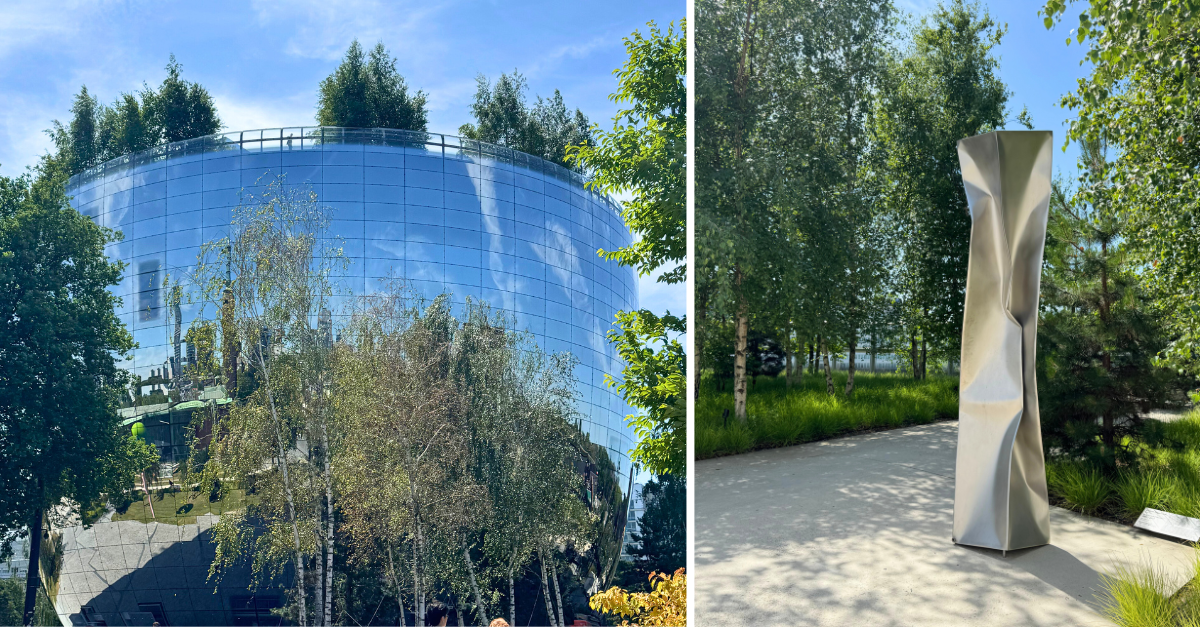
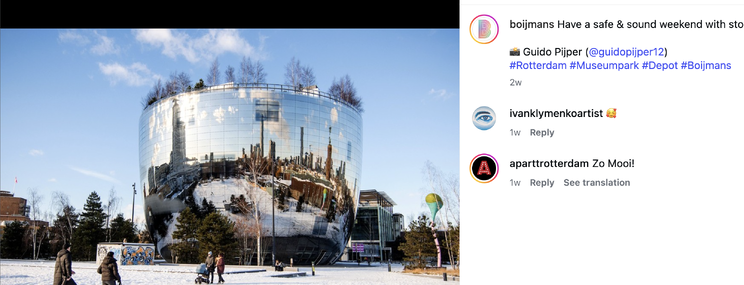
It was on our way to the hotel in Rotterdam that I first spotted the ovoid, bowl-like shape of this unique art building. It’s hard to resist the continuous mirrored surface wrapping the building and the large trees growing on top.
I had read about Depot Boijmans Van Beuningen before the trip, but seeing it with our own eyes was something else. You feel that the building continues upward, becoming landscape.
When a free, sunny afternoon opened up, I jumped at the chance to visit it. The museum is, in fact, an art depot for both Boijmans van Beuningen and private collectors—a radical approach in the art world.
The Depot, which opened in 2021, was designed to safely store artworks while they are not on display. Visitors can observe different types of storage areas, watch conservation and restoration processes in action, and see how works are packaged and transported. You can also admire selected art pieces that are creatively put on display as you walk in the Depot. Taken together, the experience was a treat in itself.
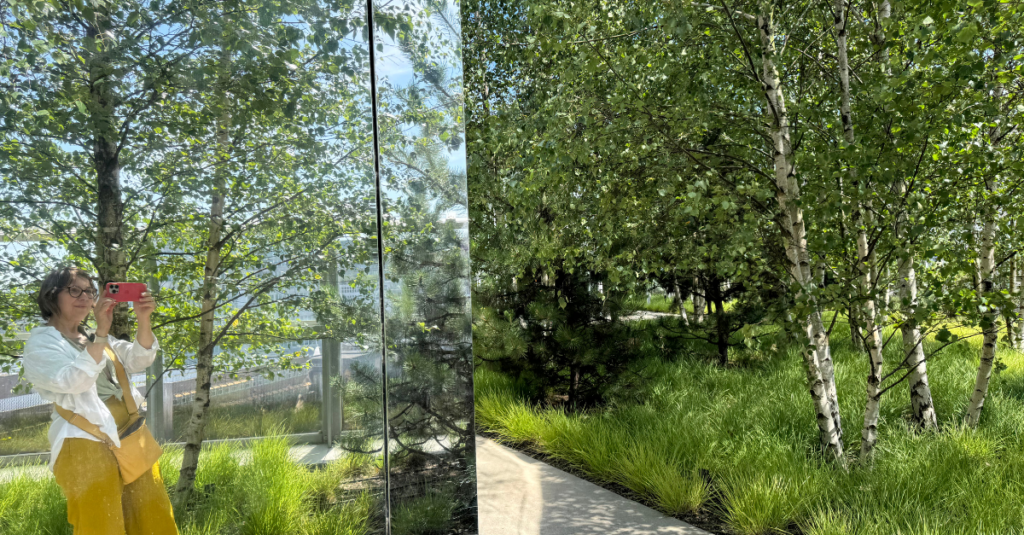
But one of the most memorable moments came when I stepped onto the peaceful rooftop forest.
As I walked, I could hear the wind moving through fir trees, grasses and the seventy-five multi-stemmed birch trees standing several metres tall. These birch trees were not planted for novelty. They respond to several needs at once: introducing biodiversity into a hardscape-heavy area, mitigating heat, and offering moments of calm in the city. Calming moments delivered by movement and scale.
At the edges of the forest, the city of Rotterdam gradually came into view, revealing different parts of the city and rounding out the experience.
This rooftop solves a simple but pressing problem: how to add nature and public space in a city where ground-level opportunities are limited. It uses height not to dominate, but to compensate.
A rooftop that brings people together — Aarhus
The Salling department store sits at a strategic location in the city of Aarhus. It sits along Strøget, the city’s popular one-kilometre-long pedestrian shopping street. Instead of treating its roof as leftover space, Salling designed it as a shared civic plaza —and, in the making, turned it into a major tourist attraction.
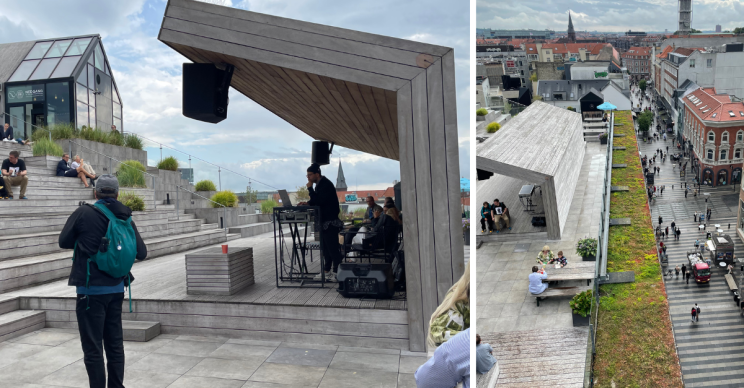
This rooftop hosts a bar, a bistro, a skywalk, a 360-degree panorama, several gathering areas, a garden park, and a stage for concerts, talks and workshops. It’s a thoughtful mix of social spaces and commercial uses.
If you look at what happens throughout the year, you quickly notice that the rooftop acts as a plaza. A plaza where cultural and social life casually meet. You can sit and relax, use the swings in the garden, or walk the skywalk without spending a dime.
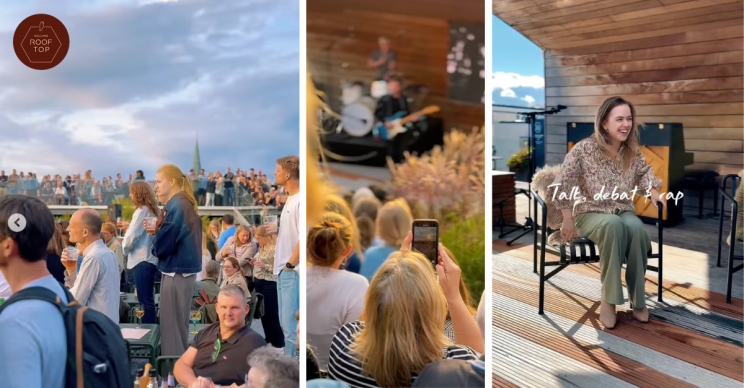
The photos make it clear that this rooftop is used and loved. It’s a lively spot high in the city. Cultural life is not pushed to the margins or confined to formal venues. It unfolds right where people already go.
The department store also benefits from providing this public space. It generates revenue from people who come for shopping, for the views, for food and drinks, or to attend events. With so much to do, chances are they stay longer than planned.
The strength of Salling Rooftop is not just greenery or views. It’s the program. The way the space is activated. Since opening, it has consistently ranked among Denmark’s top tourist attractions by visitor numbers.
Play and movement above parking — Copenhagen
Parking garages are poorly built environments. They are necessary, bulky, and typically hostile to public life. That’s precisely why the next example is so unexpected.
Konditaget Lüders is a one-of-a-kind activity park, located twenty-four metres above the ground in Nordhavn. It’s in a former industrial port of Copenhagen that was redeveloped into a dense, mixed-use waterfront neighbourhood. It’s so dense because the intent was to build a 5-minute city.
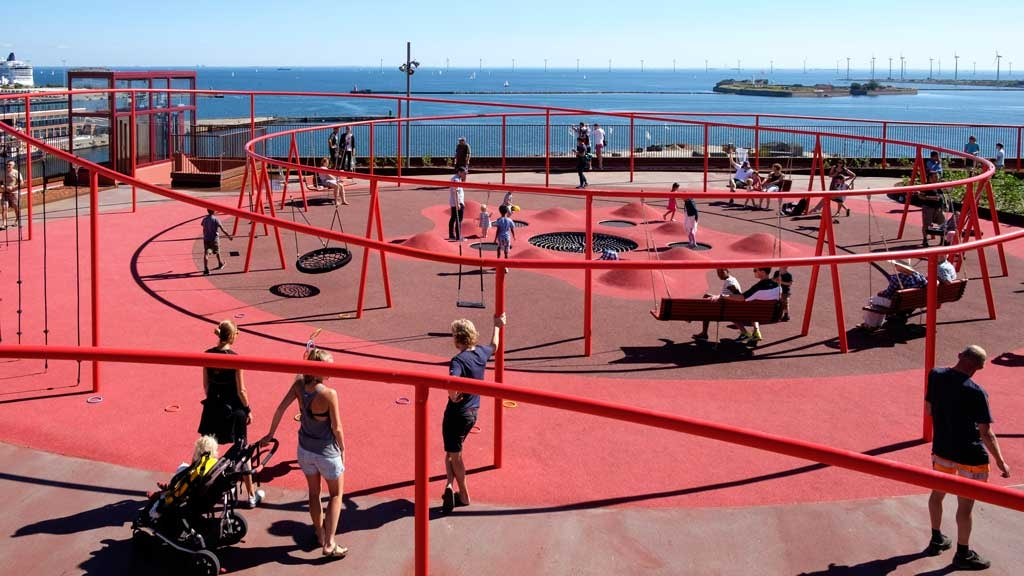
Nordhavn is one of these modern neighbourhoods where medium to large parks and public spaces are lacking. A mistake that is too common these days. This explains why this unique rooftop was built on top of a multi-storey parking structure. There was very little room for recreational space at street level around that area.
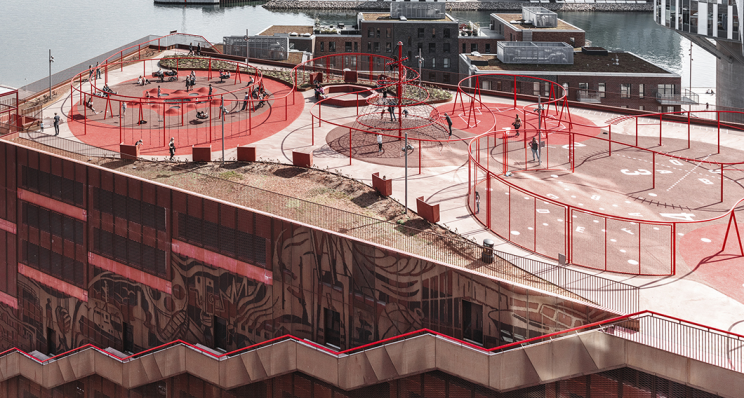
Families, teenagers, and adults can use it daily from 7 a.m. to 10 p.m. for free. They come for its wide range of outdoor activities, play, and relaxation. The circular swing structure is an attraction for people of all ages. I, for one, would love to try it.
This Park ‘n’ Play solves two problems at once: parking below, public life above. It shows how cities can be more efficient with flat surfaces, turning necessity into opportunity.
A pattern worth noticing
These rooftops are not linked by style or scale. They are linked by intent, by the way they solve an urban problem. Each one exists because the city faced constraints:
- limited land
- growing density
- pressure on public space
- the need to support daily life beyond housing.
Instead of treating rooftops as residual, these cities treated them as an available resource.
None of these projects rely on views alone. They are calm, useful, and deeply pragmatic. Meaningful innovation requires a shift in mindset—one that asks urban planners, developers, and landscape designers to see rooftops as part of the city’s working surface.
Once you notice this pattern, it becomes difficult to ignore how much potential remains untapped. And that raises a more uncomfortable question:
If rooftops can do all this, why do we still treat them as optional?
